Most IT teams track what gets logged, but meeting tech troubleshooting often lives outside that system. It's the pre-meeting scramble that happens before anyone formally requests help. It's the five-minute fix that turns into 45 minutes once you factor in the walk, the diagnosis, the workaround, and the follow-up. That time is real, but it can also be invisible. And when you're running lean, invisible costs compound fast.
What 512 IT Leaders Said About IT Workload
We asked 512 IT decision-makers to estimate how much time their teams would save each month if their top collaboration-related workload driver were eliminated.
The average answer was 52 hours per month.
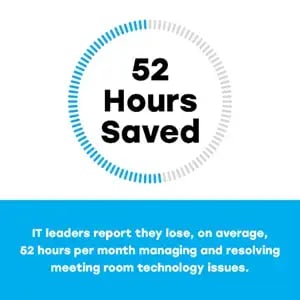
Our workplace strategy experts tell us that while 52 hours is the average number of hours survey respondents say they lose to resolving meeting room issues, the number grows at larger organizations. The specific driver causing this lost time also varies depending on organizational size.
Leaders at larger organizations (1,000+ employees) pointed to automated A/V and connectivity fixes as the highest-impact opportunity. Smaller organizations prioritized seamless system integration.
“The 52 hours of lost time each month taking care of audiovisual issues confirms what we hear from our customers. The crux of this problem is that individuals assigned to maintain meeting room solutions often get IT tickets that require troubleshooting, which takes time away from other tasks. In some cases, time spent troubleshooting and resolving a meeting room technology issue can take hours – and this lost time lives in the margins of people’s days,” said Josh Braun, Chief Information Officer at FORTÉ.
Why 52 Hours Is Likely an Undercount
What the State of Modern Collaboration Spaces survey didn’t capture from IT decision makers is the exponential workplace productivity drag that occurs when meeting technology stalls or fails:
- The eight people waiting while one person troubleshoots a connectivity issue
- The leadership team, whose 60 minutes together just became 45
- The group brainstorm that never quite got off the ground after a late start
The 52-hour figure is just what IT loses each month. Employees waiting on a resolution lose time as well.
What Gets Unlocked When the Issues Stop
When reactive support no longer fills the day, the work that’s been waiting tends to surface. Strategic priorities like:
- Security improvements: Addressing the patches, access audits, and vulnerability reviews that get perpetually bumped when reactive support fills the day
- Platform strategy: Taking a real look at whether the tools in use are actually working together, or just coexisting
- AI readiness planning: Moving from "we should evaluate this" to actually scoping what it would take to implement AI productivity tools
- Infrastructure modernization: Making progress on cloud migrations, device management standardization, or network upgrades that keep getting pushed to next quarter
That's the shift worth paying attention to. Not the hours saved, but what those hours make possible.
52 Hours Is the Average. What's Yours?
The 52-hour average is a useful benchmark, but your environment has its own fingerprint. Approximately how many hours would your team save per month if a major driver of IT workload were removed?
If you want to see how your collaboration environment compares to your peers, the full The State of Modern Collaboration Spaces report is a good place to start. And if you'd rather get specific about your own foundation, reach out.