Every organization has a room where the stakes rise a little higher. A space where leadership gathers, big decisions are made, and the experience needs to feel seamless from the moment someone steps inside.
If you’ve been asked to “refresh the boardroom” or “improve hybrid for the executive team,” what you’re really being asked is much bigger: Make this room worthy of the moments that happen here.
For IT and Facilities teams, this is both a challenge and an opportunity.
Executive environments aren’t about more tech or nicer finishes. They’re about creating a space that communicates leadership, performs flawlessly under pressure, and reflects changing expectations.
Before diving into layouts or technology decisions, it helps to pause and get aligned on purpose, audience, and experience. This post offers a practical roadmap to guide those conversations and help you move forward with confidence.
Related Reading: Norwest Venture Partners Enhances Melo Park Office with Seamless AV
Executive Conference Rooms: A Category of Their Own
Boardrooms and executive conference rooms behave differently because the expectations placed on them are different.
“In these rooms, reliability isn’t a feature – it’s the foundation,” said Eric Jingst, Enterprise Architect at FORTÉ. “Executive spaces must perform flawlessly, not just look impressive. Every design choice should protect the organization from distraction and risk.”
Executive conference rooms are:
- High stakes – board decisions, investor briefings, and crisis conversations cannot stumble.
- High visibility – these rooms are where leaders host the people whose opinions matter most.
- High complexity – including multiple presentation modes, hybrid interactions, broadcast-grade audio, privacy considerations, and more.
- High expression – the environment itself needs to communicate authority, culture, and competence.
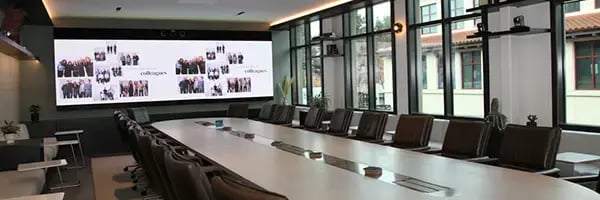
Of course, all meeting rooms contribute to how organizations collaborate. It’s just that executive spaces operate under different expectations, so decisions about experience, technology, and expression benefit from an added level of intentionality.
The Executive Meeting Room Decision Matrix
Requests to improve an executive space often begin with broad goals or impressions. This matrix helps ground the conversation, giving teams a shared way to define what the room must achieve and how it should show up for the people who use it.
1. Purpose: What must this room do at its highest moments?
- Enable board member collaboration and decision making
- Support hybrid leadership meetings
- Welcome clients or investors
- Deliver executive presentations
- Manage crisis or mission critical operations
2. Audience: Who will experience this room? And what do they expect?
- Board members and executives
- Global teams joining remotely
- Clients, analysts, partners
- Press or external stakeholders
Their expectations shape everything from lighting to acoustics to room flow.
3. Expression: What should the room say about the organization?
- Commanding and formal
- Warm and hospitality-driven
- Innovative and future-forward
- Neutral and understated
- Culturally rooted or brand-aligned
The Craft Behind an Executive Meeting Room
The best executive rooms pair precision with ease. Behind every seamless moment is a blend of design craft, technical engineering, and experience planning that ensures the space supports leadership without ever calling attention to itself.
The Experience Layer
- Lighting that creates presence and confidence (both in-room and on camera)
- Acoustics that eliminate distraction and ensure speech clarity
- Sightlines that make hybrid meetings feel natural and equitable
- Table geometry that supports discussion and decision-making
- Material choices that reinforce brand and culture
The Technology Architecture
- Studio-grade‑ cameras that preserve eye-line and presence
- Intelligent audio systems designed for conversation (not just coverage)
- Scenario-based-modes (investor, collaboration, crisis)
- Intuitive control interfaces
Reliability Engineering
- Redundant signal paths and failover
- Monitoring, alerting, and support readiness
- Rigorous scenario testing before go-live
- Custom programming to eliminate unpredictable behavior
An Executive Boardroom Playbook for IT and Facilities Leaders
When an executive space needs to evolve, it helps to have a clear starting point. This playbook offers a practical way to move from early conversations to a shared, strategic direction.
1. Translate expectations into design language
Ask leadership:
- "What impression should this room create?"
- "What moments matter most?"
- "How should this space make people feel?"
2. Define the anchor scenarios
Choose the three most critical use cases. Design around them.3. Align stakeholders early
Executive rooms are most successful when Real Estate, IT, Facilities, and AV work together rather than in parallel.
4. Prioritize the invisible foundations
Acoustics, lighting, infrastructure, and routing shape the experience more than any visible device.
5. Prototype and rehearse
Run actual investor decks. Simulate hybrid board meetings. Test failure points.
6. Document for durability
Executive spaces should be supportable, repeatable, and future-adaptable.
Your Strategic Executive Conference Room Partner
While every executive space is unique, the process required to make it successful is consistent. After working on hundreds of leadership and boardroom environments, we’ve learned what it takes to deliver rooms that perform under pressure.
If you’re considering an executive meeting room upgrade, FORTÉ’s four-step planning process can help you:- Translate ambiguous executive intent into clear project criteria
- Balance architectural vision with technical and experiential needs
- Engineer complex environments that feel simple and intuitive
- Protect the organization from risk through reliability and redundancy
- Deliver rooms that elevate leadership moments (not distract from them)
“Technology in these unique spaces should be a business enabler, not a distraction,” added Jingst. “With each customer engagement, our goal is to design rooms that strengthen leadership outcomes by making every interaction intuitive and dependable.”
Are you ready to take a conference or collaboration space to the next level? Let’s start the conversation.