Budget constraints and ROI justification tend to dominate AI adoption conversations in boardrooms, at industry events, and in many vendor pitches. But when we asked 512 IT decision-makers to rank the top barriers to integrating AI in meeting rooms, budget and ROI weren’t at the top of the list.
What the Data Shows
Security and privacy concerns were ranked the top barrier, coming in at 52-53% across organizations of all sizes. Integration with existing systems follows closely at 48%. Cost and budget constraints rank third at around 40% for both large and small organizations. Proof of ROI ranks sixth.
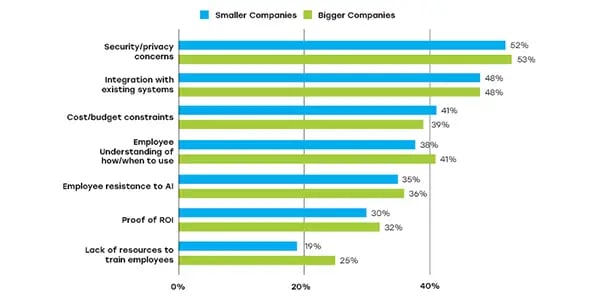
If budget justification has been the centerpiece of your AI adoption conversation, this research suggests the real friction is connecting AI tools to the environments where meetings actually take place.
The Integration Challenge Is Where Adoption Stalls
For enterprise organizations, meeting room environments involve a dense ecosystem of hardware, software, platforms, and room configurations that vary by location, room type, and use case.
That makes fragmented meeting room environments, with inconsistent configurations, ungoverned hardware, and platforms that vary by location and room type, more than an integration headache. It makes them a security and privacy liability, too.
Getting AI tools to work reliably within this context requires deliberate infrastructure work long before employees ever interact with a new feature.
When the groundwork is skipped or underestimated, AI adoption can stall quietly as features go unused and workarounds become habits. In these cases, AI is sitting on top of an environment that was never ready to support it.
“Organizations that are make real progress with AI aren’t treating integration as a checklist item, they’re treating it as a strategic foundation,” said Jason Moulden, Vice President of Intelligent Workplace at FORTÉ. “They’re standardizing their environments, aligning platforms, and doing the infrastructure work upfront so AI can actually function the way it’s intended. Without that, even the best tools struggle to deliver value.”
The Readiness Gap Is the Other Half of the Problem
Once the environment is integrated and stable, another barrier surfaces: employee understanding of how and when to use AI tools, cited by 38-41% of respondents. This is not the same thing as employee resistance, which ranked just slightly lower at 35-36%. The distinction between the two matters because readiness is an implementation problem that organizations can actually solve.
In Microsoft-heavy environments, this shows up with particular clarity. AI capabilities inside Teams, Copilot, and related tools are only as valuable as employees' ability to use them with confidence and consistency. Larger organizations feel this acutely: the research found that lack of resources to train employees was cited at a notably higher rate among bigger companies, pointing to a scale problem that deployment alone cannot solve.
“The organizations that see the most success with AI adoption are building training and change management into the rollout from day one,” added Moulden. “They’re not waiting until after deployment to think about adoption. Instead, they’re designing for it. This includes ongoing support, clear use cases, and making sure employees understand how AI fits into their daily workflows.”
Two Problems, One Through-Line
The integration barrier and the readiness barrier are related. Skip either one, and AI adoption stalls, just at a different point in the process.
Our advice is to solve the infrastructure problem first, then solve the readiness challenge. That sequencing is not a project management detail. For IT leaders responsible for both the technology and the people using it, it is the whole job.
See the Full Picture
Download the report, The State of Modern Collaboration Spaces, to learn more about what IT leaders are prioritizing now.